
What Is the Future of the Transportation Business?
Structural shifts in technology, regulation, and labor markets actively redefine how freight moves across the country. The future of the transportation business is not a distant projection. Rather, it is an operational reality already underway in fleet management systems, regulatory agencies, and carrier boardrooms. Furthermore, understanding these forces is essential for any company that depends on commercial trucking to move freight competitively and compliantly.
Automation and Advanced Driver Assistance Systems
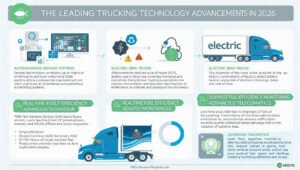
Autonomous vehicle technology continues advancing along a regulatory and commercial timeline that will eventually affect most fleet operators. The FMCSA has reviewed regulatory frameworks for automated driving systems, and several states have additionally enacted their own AV testing and deployment statutes. Semi-autonomous features such as adaptive cruise control, automatic emergency braking, and lane-keeping assistance now come standard in many new Class 8 trucks. Therefore, carriers that invest in newer equipment already operate on the early edge of what the future of the transportation business will normalize.
Electric Vehicles Entering Commercial Fleets
Battery-electric commercial trucks have moved from prototype status to limited production deployment. Regulatory pressure at both the federal and state level accelerates the timeline for fleet electrification. Moreover, the EPA’s Phase 3 greenhouse gas emissions standards for heavy-duty vehicles push zero-emission vehicle adoption progressively through the next decade. Consequently, fleet operators must now evaluate charging infrastructure, range limitations, and total cost of ownership as part of long-term equipment planning rather than treating electrification as a future concern.
Data Integration and the ELD Ecosystem
ELD mandates transformed how Hours of Service compliance works, and that data infrastructure now continues expanding. The future of the transportation business includes deeper integration between ELD data, safety scoring systems, and predictive analytics platforms. Furthermore, FMCSA has signaled ongoing interest in using telematics data to improve Safety Fitness Determination methodologies. As a result, the data a driver generates daily will carry increasing regulatory and commercial weight for every carrier operating under federal authority.
Solving the Driver Shortage
The American Trucking Associations documents a persistent driver shortage that deepens as a large portion of the current workforce approaches retirement age. Additionally, ATA reports indicate the industry could face a shortage exceeding 160,000 drivers within the next decade if current trends continue. Addressing that gap therefore requires investment in driver recruitment, CDL training programs, and retention strategies. Expanded entry-level driver training standards under FMCSA rules also represent one regulatory response to the pipeline development challenge carriers now face.
Freight Technology as a Baseline Expectation
Shippers increasingly demand real-time load visibility, automated status updates, and integrated booking platforms. Carriers that cannot provide this level of data connectivity consequently risk losing freight to competitors who can deliver it. Freight technology companies have raised substantial capital to build platforms that connect shippers, brokers, and carriers through application programming interfaces that share tracking and appointment data automatically. Therefore, technology adoption in the future of the transportation business no longer functions as a competitive differentiator. Instead, it functions as a baseline operational expectation.
Regulatory Developments Carriers Must Monitor
Several significant regulatory changes currently move through federal rulemaking processes. Speed limiter mandates for commercial motor vehicles have circulated through FMCSA and NHTSA consideration for years and may therefore advance toward a final rule soon. Broker transparency rules affecting freight payment and fee disclosure additionally represent an active area of regulatory development. Moreover, HOS flexibility provisions continue generating debate among carriers, drivers, and safety advocacy organizations. Consequently, staying ahead of rulemaking activity now ranks as a strategic necessity for every carrier.
Insurance Costs and the Nuclear Verdict Problem
Commercial trucking insurance costs have escalated sharply in recent years, driven in part by high-value jury awards in trucking litigation. Industry analysts and insurance carriers document a pattern of nuclear verdicts where jury awards exceed $10 million in cases involving commercial vehicle accidents. As a result, safety investment, driver training, and documentation discipline now carry financial significance that extends well beyond their regulatory function. Additionally, the future of the transportation business requires carriers to manage liability risk as rigorously as they manage fuel and maintenance costs.
Reshoring and Domestic Freight Demand
Geopolitical pressures and supply chain disruptions accelerate a trend toward domestic manufacturing and nearshoring of production capacity. This shift consequently generates additional truckload freight demand within North American corridors. FreightWaves and other industry analysts note that infrastructure investment under recent federal legislation will furthermore create construction-related freight activity over the coming years. Therefore, long-term freight demand fundamentals remain supportive even as short-term market cycles fluctuate through their normal patterns.
Actionable Priorities for Carriers Preparing for the Future
- Evaluate fleet electrification timelines and infrastructure requirements before regulatory deadlines create reactive pressure.
- Invest in driver recruitment and retention programs to address workforce pipeline risk proactively.
- Adopt freight technology platforms that give shippers real-time visibility and automated communication.
- Monitor FMCSA rulemaking activity closely, particularly speed limiter and HOS-related proposals.
- Strengthen safety documentation and training programs to reduce liability exposure in high-verdict litigation environments.
- Assess telematics and data analytics capabilities to position for evolving Safety Fitness Determination criteria.
Key Takeaways
The future of the transportation business takes shape around five converging forces: automation, electrification, data integration, workforce constraints, and regulatory evolution. Driver shortages will intensify without deliberate investment in pipeline development. Furthermore, insurance costs will continue rising unless safety performance improves at the fleet level. Technology adoption has additionally shifted from competitive advantage to operational baseline. Regulatory changes across multiple areas already move through federal processes and will therefore require carrier adaptation. Carriers that treat these trends as strategic priorities rather than background noise will consequently operate effectively through the next decade.
Carriers that grasp these dynamics and act on them now will not merely survive the future of the transportation business. They will lead it.
Source: American Trucking Associations (trucking.org), FMCSA (fmcsa.dot.gov), FreightWaves, EPA (epa.gov), Commercial Carrier Journal, CVSA.org